[continued from #2]
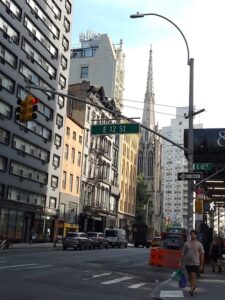
Arthur Machen’s Ars Magna of London (‘an adventure into the unknown’) can just about be applied to Manhattan’s street grid; getting lost is admittedly much harder, given that every avenue/street intersection offers a coordinate, but I was mostly without map or guidebook. Machen advises the walker to lay aside all historical associations; again, hard to do when every skyscraper is a landmark with its own cultural baggage. At least there were some surprises, such as encountering Trump Tower on Fifth Avenue, its ground floor a gilded shopping mall open to the public. Or witnessing a naked man being ushered into a police car in Times Square. Aiding me in my practice was the intense July heat which had followed me from Austin, providing the creeping delirium needed for glimpsing Machen’s ‘Great Magisterium’. I was grateful when, at the end of the day, I could retreat to an air-conditioned hostel room, albeit the same size and style as a prison cell.
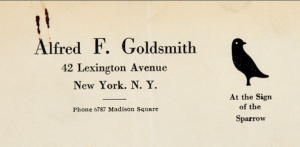
Machen was of course never in New York City – the second stop on my American archive tour – and never expressed any interest in being there. But it was the epicentre of the Machen ‘boom’, home to the offices of Alfred A. Knopf who published the majority of Machen’s American editions in the 1920s. A handful of devoted New Yorkers kept up a voluminous correspondence with Machen. One such was Alfred F. Goldsmith, owner of a bookshop at 42 Lexington Avenue, ‘At the Sign of the Sparrow’. Goldsmith seemed to have cultivated a faux-Gothic exclusivity in his shop, unswept and accessed via a staircase leading below street level. It was also supposedly the setting for two mystery novels. Stockbroker and book collector Edward Naumburg remembered the Sparrow as ‘dimly lighted, warmed by a gas stove, lined of course with bookshelves, and divided by a flimsy partition beyond which was the inner sanctum where rarities were kept. The average customer was not invited to enter’. Presumably beyond the partition (or penetrable veil) a row of Machen rarities lay waiting.
Another correspondent was Carl Van Vechten, novelist, dance critic, socialite, promotor of the Harlem Renaissance and African American culture more generally. It was Van Vechten who recommended Machen’s work to Knopf while an assistant there and wrote some of the earliest appreciations of Machen in American newspapers (one of which was collected in his book Excavations). It’s a wonder he had any time to write to Machen, who was then in his sixties and completely at odds with Van Vechten’s lifestyle; Machen himself did not seem particularly aware of Van Vechten’s wider cultural pursuits, and would have been uneasy to learn of his bisexual proclivities. For the most part, their correspondence remained safely on the topic of Machen’s books, which Van Vechten valued for their ‘rarified’ aesthetic qualities, hoping that The Hill of Dreams and The Secret Glory might counteract the current vogue for realism (take that, Dreiser).
The New York Public Library holds around two dozen letters Machen wrote to Van Vechten, not to mention fifty to the Irish novelist Norah Hoult. Hoult visited New York and various points, relying on Machen’s letters of introduction for bed and board. It is from her that Machen received a picture of East coast literary society and came quickly to the conclusion that he was no glad not to be part of it. Machen’s letters to Hoult are arguably of far more interest than Van Vechten’s for their informal tone, details of daily life, and the fact that the pair corresponded well into the 1940s.
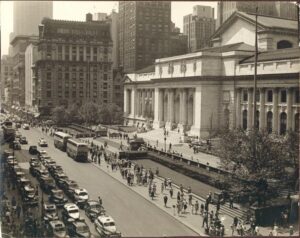
So having spent a cool yet siren-filled night (from the NYPD station across the street), I set out for the Library’s Main Branch. Its neoclassical exterior is not unlike the British Museum, but its innards were designed in the then-fashionable ‘Beaux-Arts’ style, similar to nearby Grand Central Station, opened around the same time (early 1910s). Passing through the airport-style security check, I made my way first to complete my registration, and then to a separate desk in the famous sky-vaulted Rose Main Reading Room to collect my library card. Then up a floor or two to a wooden door. Either a class was being held, or the library team were in a meeting. I turned back to see the corridor-full of visitors staring at me, more interested in why I had tried to enter this mysterious room than the ‘Century of the New Yorker’ exhibition on display. Clutching laptop and notebook, I passed the time peering at the old magazine covers lining the walls. Machen was sometimes reviewed in The New Yorker during the 1930s, and over a hundred of his niece Sylvia Townsend Warner’s short stories were published in its pages. There is always a Machen connection if you look hard enough. (To dig a bit deeper, it was also the centenary year of the Library’s Walt Whitman exhibition, curated by Alfred Goldsmith).
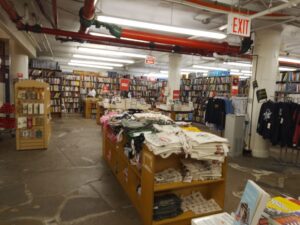
Finally, I was beckoned into the room. I had requested everything, which kept me occupied for the morning. Outside I sat blinking in Bryant Park, eyeing the chess boards but feeling too frazzled to make a challenge. I idled off instead to buy honey-roasted peanuts and go in search of the Strand bookshop. Tomorrow, the promise of Penn Station and the Amtrak to New Haven, Connecticut, and what I imagined to be the cool leafy avenues of Yale University and the Beinecke Library, home to the discarded final chapters of The Secret Glory…
References / further reading
- Arthur Machen, Things Near and Far (London: Martin Secker, 1923)
- See Carl Van Vechten’s Wikipedia entry for a good selection of his portrait photography.
- Brotmanblog is a fantastic resource for Alfred Goldsmith and bookselling in early twentieth-century New York City.