A few weeks ago writer and host Conner Habib invited me onto his podcast to discuss the Order of the Golden Dawn — we talked about the writing of the book, the importance of taking a side (or not), the occult and psychology, and much else besides. This was a genuine pleasure. My media baptism of fire continues!
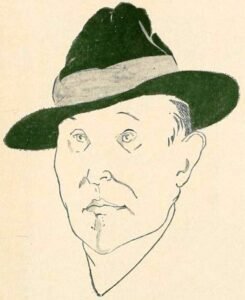
The literary periodical The Reviewer was founded in Richmond, Virginia, in 1921 by Emily Tapscott Clark, Hunter Stagg, Mary Dallas Street and Margaret Freeman, and ran for 35 issues until its demise in 1925. Early contributors included H. L. Mencken, James Branch Cabell, Carl Van Vechten and Joseph Hergesheimer (whom Clark dubbed the magazine’s four ‘godfathers’). Clark aimed at promoting the writers of the Southern literary renaissance, the new ‘Southern consciousness’, as she put it. Mencken, the acerbic Baltimore journalist, approved of the periodical’s aims and declared as much in the inaugural issue: ‘The editors know what sort of stuff they need to break down the old Southern tradition and prepare the path for better things’.
H. L. Mencken by Djuna Barnes (public domain)
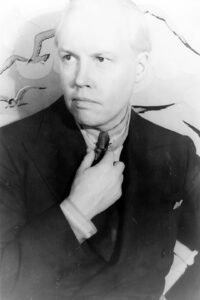
For a writer who had never tried very hard to cultivate a reputation in America, Arthur Machen’s name cropped up surprisingly often. Hunter Stagg, in his article ‘Some Literary Curiosities’, singles out Machen’s The Three Impostors as a work of ‘strangeness and fantasy’ that outperforms Robert Louis Stevenson’s More New Arabian Nights, from which Machen borrowed his book’s structure and caperish energy. ‘Mr Machen’s tales not only deal with the mysterious, but frequently make horrible excursions into the occult, our modern substitute for Afrit and wizard law of old’. In January 1924, Carl Van Vechten reviewed Ornaments in Jade, Machen’s collection of vignettes written in the mid-1890s but not published together until 1924. Characteristically, Van Vechten casts Machen as a hermetic writer whose work can only be fully understood by the initiated: ‘A few readers will divine the orphic secrets; all readers will appreciate the suavity of the prose’. In July of the same year The Reviewer reprinted Machen’s essay ‘The Ten Thousand and One Nights’, which had been written for the Evening News in 1913 to celebrate its 10,000th issue. A copy had been given to The Reviewer by collector Charles Parsons. The fanatical New York businessman and correspondent of Machen’s Frederick Eddy (Clark privately thought him annoying) reviewed The Secret Glory in a 1922 issue.
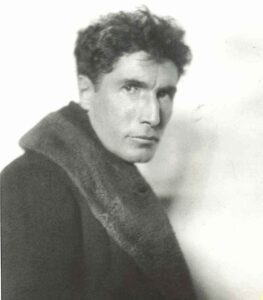
Carl Van Vechten, self portrait (public domain)
Machen’s star had been rising in America for a number of years. By 1923 his books were commanding high prices at auction houses and his memoirs were being published by the New York firm Alfred A. Knopf. The Reviewer’schief editor Emily Tapscott Clark, born in Richmond in 1892, did not herself appear particularly interested in Machen’s work at the time, but some of her associates certainly did. Hunter Stagg was particularly enthusiastic and visited Machen in London in the summer of 1923 with Montgomery Evans (‘they seem to have all got very drunk together’, reported Clark). James Branch Cabell was another early admirer, as was Van Vechten. Perhaps inevitably, H. L. Mencken was the odd one out; he considered Machen to be a failure whose revival was unearned, and roasted the Welshman in an article for his own magazine The Smart Set.
Clark also seems to have asked Machen for pieces to publish, as she did with British writers John Galsworthy, Ronald Firbank and Aleister Crowley (who provided an article on Cabell). The Reviewer could not afford to pay its contributors, and so freebies from established authors were seen as a way to lure regional Southern writers into submitting their work without financial reward. It was Frederick Eddy who managed to get Machen to send over his ‘Notes on The Secret Glory’, published as ‘The Treasure of the Humble’ in January 1923. A version of this was later included in Henry Danielson’s Arthur Machen: A Bibliography that same year.
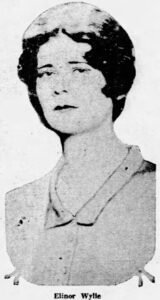
Clark resigned the editorship in 1924 after her marriage to the philanthropic Edwin Balch (who had financed several issues himself), and the journal folded soon after. But this did not end her association with Machen. Clark travelled to London in July 1926 with the poet and notorious beauty Elinor Wylie. Wylie (‘She spent money’, Clark remembered, ‘always, magnificently and inconsiderately’) darted about the city paying calls to notable writers of the day, including Virginia Woolf. One of these writers was Machen, who Wylie visited ‘unintroduced’ at his home in St John’s Wood to drink his famed Dog and Duck punch. Clark seems not to have been present on this occasion, for her brief account of Wylie’s visit is written in the third person (unlike their earlier meeting with Walter de la Mare), but she may have called in later years — Machen certainly mentions her visiting in summer 1938. Clark wrote about the London trip, and her experiences of editing The Reviewer in her book of anecdotes Innocence Abroad (1931); it included reminiscences of old friends such as Carl Van Vechten, whom she used to meet for lunch at the Algonquin Hotel, New York. She sent a copy to Machen, who read it with interest: ‘Most entertaining; but I don’t think I should have been at ease in the little circle at the Algonquin’.
Elinor Wylie in 1928, around the time she visited Machen (public domain)
Sources referred to:
Ingenue Among the Lions: The Letters of Emily Clark to Joseph Hergesheimer (Austin: University of Texas Press, 1965). Emily Clark, Innocence Abroad (New York: Alfred A. Knopf, 1931). Available online. The Reviewer, volumes 1-4. Available online. James Branch Cabell website, the Virginia Commonwealth University.
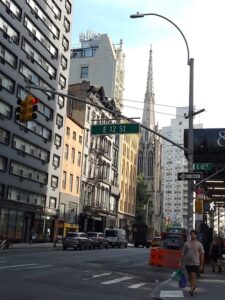
Arthur Machen’s Ars Magna of London (‘an adventure into the unknown’) can just about be applied to Manhattan’s street grid; getting lost is admittedly much harder, given that every avenue/street intersection offers a coordinate, but I was mostly without map or guidebook. Machen advises the walker to lay aside all historical associations; again, hard to do when every skyscraper is a landmark with its own cultural baggage. At least there were some surprises, such as encountering Trump Tower on Fifth Avenue, its ground floor a gilded shopping mall open to the public. Or witnessing a naked man being ushered into a police car in Times Square. Aiding me in my practice was the intense July heat which had followed me from Austin, providing the creeping delirium needed for glimpsing Machen’s ‘Great Magisterium’. I was grateful when, at the end of the day, I could retreat to an air-conditioned hostel room, albeit the same size and style as a prison cell.
NYC’s holy mysteries – a typical street view (author’s photo)
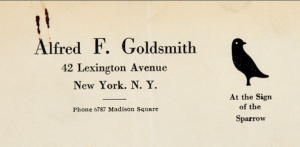
Machen was of course never in New York City – the second stop on my American archive tour – and never expressed any interest in being there. But it was the epicentre of the Machen ‘boom’, home to the offices of Alfred A. Knopf who published the majority of Machen’s American editions in the 1920s. A handful of devoted New Yorkers kept up a voluminous correspondence with Machen. One such was Alfred F. Goldsmith, owner of a bookshop at 42 Lexington Avenue, ‘At the Sign of the Sparrow’. Goldsmith seemed to have cultivated a faux-Gothic exclusivity in his shop, unswept and accessed via a staircase leading below street level. It was also supposedly the setting for two mystery novels. Stockbroker and book collector Edward Naumburg remembered the Sparrow as ‘dimly lighted, warmed by a gas stove, lined of course with bookshelves, and divided by a flimsy partition beyond which was the inner sanctum where rarities were kept. The average customer was not invited to enter’. Presumably beyond the partition (or penetrable veil) a row of Machen rarities lay waiting.
At the Sign of the Sparrow, from 1923
Another correspondent was Carl Van Vechten, novelist, dance critic, socialite, promotor of the Harlem Renaissance and African American culture more generally. It was Van Vechten who recommended Machen’s work to Knopf while an assistant there and wrote some of the earliest appreciations of Machen in American newspapers (one of which was collected in his book Excavations). It’s a wonder he had any time to write to Machen, who was then in his sixties and completely at odds with Van Vechten’s lifestyle; Machen himself did not seem particularly aware of Van Vechten’s wider cultural pursuits, and would have been uneasy to learn of his bisexual proclivities. For the most part, their correspondence remained safely on the topic of Machen’s books, which Van Vechten valued for their ‘rarified’ aesthetic qualities, hoping that The Hill of Dreams and The Secret Glory might counteract the current vogue for realism (take that, Dreiser).
The New York Public Library holds around two dozen letters Machen wrote to Van Vechten, not to mention fifty to the Irish novelist Norah Hoult. Hoult visited New York and various points, relying on Machen’s letters of introduction for bed and board. It is from her that Machen received a picture of East coast literary society and came quickly to the conclusion that he was no glad not to be part of it. Machen’s letters to Hoult are arguably of far more interest than Van Vechten’s for their informal tone, details of daily life, and the fact that the pair corresponded well into the 1940s.
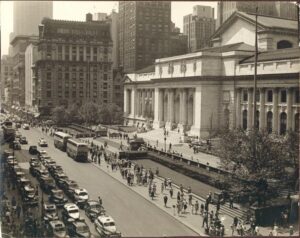
New York Public Library in 1940
So having spent a cool yet siren-filled night (from the NYPD station across the street), I set out for the Library’s Main Branch. Its neoclassical exterior is not unlike the British Museum, but its innards were designed in the then-fashionable ‘Beaux-Arts’ style, similar to nearby Grand Central Station, opened around the same time (early 1910s). Passing through the airport-style security check, I made my way first to complete my registration, and then to a separate desk in the famous sky-vaulted Rose Main Reading Room to collect my library card. Then up a floor or two to a wooden door. Either a class was being held, or the library team were in a meeting. I turned back to see the corridor-full of visitors staring at me, more interested in why I had tried to enter this mysterious room than the ‘Century of the New Yorker’ exhibition on display. Clutching laptop and notebook, I passed the time peering at the old magazine covers lining the walls. Machen was sometimes reviewed in The New Yorker during the 1930s, and over a hundred of his niece Sylvia Townsend Warner’s short stories were published in its pages. There is always a Machen connection if you look hard enough. (To dig a bit deeper, it was also the centenary year of the Library’s Walt Whitman exhibition, curated by Alfred Goldsmith).
Finally, I was beckoned into the room. I had requested everything, which kept me occupied for the morning. Outside I sat blinking in Bryant Park, eyeing the chess boards but feeling too frazzled to make a challenge. I idled off instead to buy honey-roasted peanuts and go in search of the Strand bookshop. Tomorrow, the promise of Penn Station and the Amtrak to New Haven, Connecticut, and what I imagined to be the cool leafy avenues of Yale University and the Beinecke Library, home to the discarded final chapters of The Secret Glory…
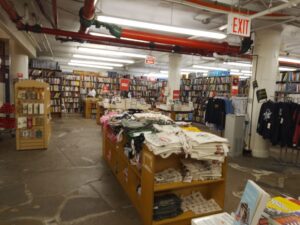
Inner workings of The Strand Bookshop (author’s photo)
References / further reading
Arthur Machen, Things Near and Far (London: Martin Secker, 1923)
See Carl Van Vechten’s Wikipedia entry for a good selection of his portrait photography.
Brotmanblog is a fantastic resource for Alfred Goldsmith and bookselling in early twentieth-century New York City.
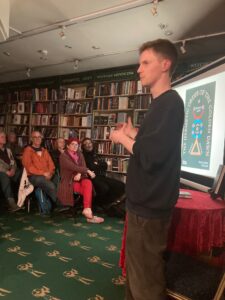
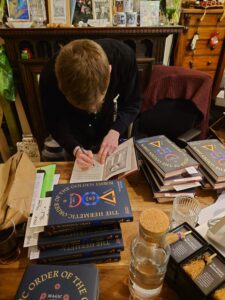
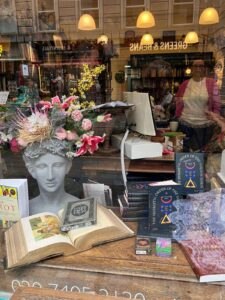
As The Hermetic Order of the Golden Dawn was published in the UK just over a month ago (two weeks in the US), I want to post a few images from the launch events, partly for my own documentation but more to share the kind of visual responses that the book has inspired. I spoke at three bookshops, one New York-based museum (online) and a university. I met artists, writers, practitioners, academics and editors; I met freemasons and booksellers, all of them full of enthusiasm and eager to talk with me about their own experiences with (or scepticism of) the Golden Dawn. It’s over for now, and I can’t pretend that my introverted bookish self isn’t grateful — but here’s to many more events like these!
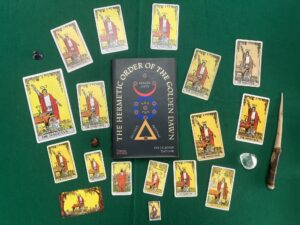
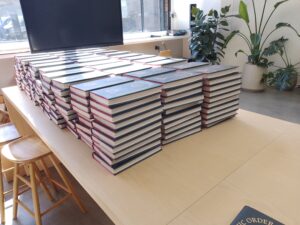
Surrounded by the Magician tarot. Image by Alan Outten.At Thames & Hudson. Reader, I signed them all.Watkins Books, 3rd AprilAtlantis Books’ ad campaignShackled to the desk, I sign the stock. Atlantis, 25th March.A tasteful window display? Atlantis Books.
Last Friday I recorded a podcast with James of the Hermitix podcast — we go through the main literary and artistic characters in the Golden Dawn’s history (Yeats, Florence Farr, Arthur Machen, A. E. Waite, etc), and discuss why so many were attracted to the Order’s magic system in the 1890s and beyond.
Watch me thinking out loud for an hour! I’ll improve at these, I promise.
One of the more sensational episodes in the history of the Order of the Golden Dawn, now part of its legend, is the Battle of Blythe Road, so called by historian Ellic Howe because it took place at the Order’s premises in Blythe Road, Hammersmith. ‘Battle’ is one way of putting it, for no blows (magical or otherwise) were exchanged. What happened was a confrontation between two factions of the Order: a very young Aleister Crowley who represented the interests of the GD’s exiled leader, S. L. Mathers, and the poet W. B. Yeats, defender of the Order’s original vision. The major detail recalled by most people with passing knowledge of the Battle is apocryphal: that it concluded with Yeats kicking Crowley down a flight of stairs. It appears to have originated in an article written by Yeats biographer Richard Ellmann in 1948 marking Crowley’s death:
Making the sign of the pentacle inverted and shouting menaces at the adepts, Crowley climbed the stairs. But Yeats and two other white magicians came resolutely forward to meet him, ready to protect the holy place at any cost. When Crowley came within range the forces of good struck out with their feet and kicked him downstairs.
Crowley seems to have related this detail to Ellmann because it was not part of any of the eyewitness accounts. As the Hermetic Library puts it, ‘Yeats did not Yeet Baphomet’.
Crowley in his youth, possibly at Cambridge
In February 1900 a revelation had thrown the GD into an identity crisis: Mathers claimed that the series of letters giving the original founders authority to establish the Order were forgeries. A committee was set up to investigate. Crowley was denied initiation into the Second Order in London for reasons to do with his sexual promiscuity (and, connected with this, an attempt to ‘gain magical power’), and so he had sought out Mathers at his home in Paris, who did not hesitate to initiate Crowley into the Ahathoor Temple. Though still commanding considerable influence in occult circles, Mathers had grown increasingly paranoid and dictatorial in his oversight of the GD in Anglia (in England). This was producing a rift between students loyal to Mathers and those who disagreed with his style of leadership, but his aspersions of forgery against co-founder William Westcott set the stage for the final break.
When it was made clear to Crowley that his Second Order initiation would not be officially recognised by Isis-Urania, he wrote to Mathers at the end of March ‘offering’ his service. While he waited for the reply, Crowley travelled to London where on 6 April he tried to gain entry to the Second Order’s headquarters at 36 Blythe Road. These were a set of first-floor room rented by actress Florence Farr from Mr C. E. Wilkinson, a builder whose office were on the ground floor. It was where the Second Order stored their ritual props (including a magnificent construction known as the Vault of the Adepts, the door of which was kept locked), and, importantly, documents relating to the Order including a list of initiates. A member named Maud Cracknell was on duty and refused Crowley entry. Cracknell seems to have misled him by claiming not to have a key to the Vault, and Crowley, unfamiliar with how the Second Order operated, believed her. Immediately Cracknell then wrote to another member explaining what had happened.
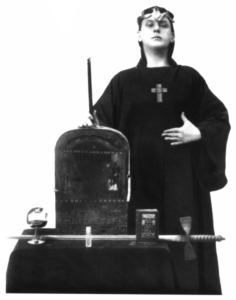
Crowley in ritual dress, 1912
Before retreating to Paris, the thwarted Crowley met with two other members, Elaine Simpson and her mother Beatrice, to solicit their support for Mathers. Elaine was a new Second Order initiate, he reasoned, and could therefore be useful. Crowley then crossed the channel and was with Mathers and his wife Moina on 9 April where he submitted a list of ‘proposals’ for how he wished to proceed, including summoning all Second Order members to him in London. There he would then interrogate them individually (Crowley would be masked) ,and if members failed to recognise Mathers as the true head of the Order and refused to sign a written statement to that effect, then Crowley would expel them. He also proposed a new rule of anonymity: all members were to wear masks and were to know the identity only of the member who had first introduced them to the Order. Mathers approved, and sent Crowley on his way.
In hindsight this is all quite funny: Crowley’s arrogance and belief in his success are part of what gives the events of 16-19 April such bathos. He was twenty-four at the time, a relatively junior student, and here he was on his way back to London with the intent to grill senior members and take over as Mathers’s lieutenant. His actions were motivated by at least two factors: spite towards what he considered an elitist membership who had rejected him out of hand (this is certainly true from a literary standpoint; Crowley saw himself as a talented poet, but Yeats was scornful of the work Crowley showed him), and desire to seek real occult influence within the Order’s hierarchy. Mathers represented a direct link to the supernatural ‘Secret Chiefs’ who had supposedly communicated to him the teachings of the Second Order. ‘He was unquestionably a Magician of extraordinary attainment’, Crowley wrote in his Confessions: ‘He had that habit of authority which inspires confidence because it never doubts itself’. Crowley was snatching at power while getting back at those who had snubbed him.
On Monday 16 April Crowley was back at Blythe Road, this time with Elaine Simpson (who, as a recognised 5˚ = 6˚, was authorised to enter the rooms) and a set of keys borrowed from Edward Berridge, another follower of Mathers. Crowley changed the locks and added his own Order motto to the membership list: ‘Perdurabo, Jan. 23, 1900’. Edmund Hunter records what happened next.
On Tuesday, 17th instant, I received a telegram from Miss Cracknell to come at once to Blythe Road. On arriving I found that the rooms which had been closed by Order of Mrs. Emery [Florence Farr] had been broken into. On entering, after a certain resistance, I found there Aleister Crowley and Miss Elaine Simpson, who declared that they had taken possession by the authority of MacGregor Mathers, and showed me documents to that effect.
Florence Farr was summoned to the scene and fetched a constable, but Wilkinson was away and she could not prove ownership of the rooms. There was nothing to be done. Crowley recorded in his notebook: ‘Fight, police, victory’. The same day he sent off letters summoning all members to Headquarters on Friday (20 April) ‘By order of Deo Duce Comite Ferro [Mathers]’.
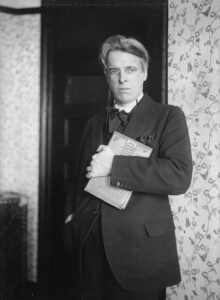
W. B. Yeats, unknown date
Yeats did not enter the fray until the morning of Thursday 19th. He and Edmund Hunter went early to see Wilkinson with a letter from Farr asking for the locks to be changed back. The two men then stood guard in the rooms until 11.30am when Crowley arrived in costume. He wore ‘Highland dress, a black mask over his face, and a plaid thrown over his head and shoulders, an enormous gold or gilt cross on his breast, and a dagger at his side’. Wilkinson stopped him in the back hall, and Yeats and Hunter came down. Once again, a constable was summoned, but this time ownership of the rooms could be proved, and Crowley had no choice but to leave. It was the final ‘theatrical farce’ in a fortnight of plans, posturing, and threats.
No one was kicked down a flight of stairs, but the Battle of Blythe Road was still decisive for the Order’s future. Mathers was exposed as a villain and was quickly suspended from the GD by the Committee in a meeting on 21 April where a new constitution was proposed. Yeats’s role in hindering Crowley’s plans was minor, but pitting the two poets against one another provides a neat representation of the wider schism in the GD. Yeats was devoted to ensuring the Order’s survival: magic was an important part of his creative and personal life, and to see it overthrown and disfigured was anathema. In contrast, Crowley was young and irreverent, overly ambitious (before he took Blythe Road, he had been preparing the dangerous Abra-Melin summoning ritual) and willing to side with an authoritarian leader for a chance at power (he would go on to reject Mathers and form his own ritual order). Yeats was an experienced poet and playwright, at the forefront of several literary movements; Crowley had written masses of derivative erotic verse, mostly unedited and privately printed at his own expense. The Battle of Blythe Road was a pivotal event and underscored the divide between two very different forces in occultism and literature.
Sources:
Ellic Howe, Magicians of the Golden Dawn (Aquarian Press, 1985)
The Hermetic Library website
Aleister Crowley, The Confessions of Aleister Crowley (Penguin, 1989)
See this very good video made by Niall McDevitt, filmed on present day Blythe Road for the Irish Cultural Centre.
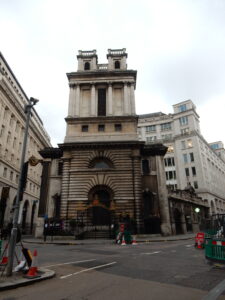
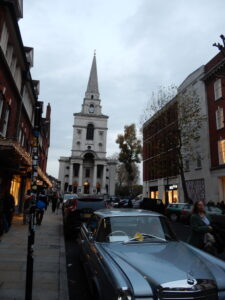
There’s been no time for a research blog post over these past few months — so to disperse feelings of guilt and shame, I’d like to share a handful of images taken this time last year on a walking tour of the Hawksmoor Six. The architect Nicholas Hawksmoor designed these churches as part of a 1711 parliamentary act commissioning fifty be built in the Cities of London and Westminster (known also as the Queen Anne Churches only twelve of which were completed). Modern writers have played around with ascribing occult significance to the positioning of Nick’s buildings, beginning with Iain Sinclair in Lud Heat, published in 1975.
Squat St Mary Woolnoth, near the Bank of EnglandChrist Church Spitalfields, with Gothic spireSt George in the EastSt Anne’s Limehouse, gutted by fire in 1850, soon restored
Before the British illustrator Leonard Raven-Hill started as a Punch cartoonist in December 1895, he edited a magazine called The Unicorn: An Illustrated Weekly for Society at Home and Abroad, which ran for at least two issues. Like the eponymous cryptid, very little information can be uncovered about its true nature: no scans exist on online periodical archives, no lists of contents on databases. The best statement of fact comes from the art critic Marion Spielmann, who profiled Raven-Hill for the Magazine of Art in 1896. The Unicorn was ‘born to an ineffectual struggle of only three weeks,’ he wrote, ‘[and] succumbed to its birth-throes through misunderstanding and financial mismanagement’.
But why should we be interested in this short-lived publication? For one, Raven-Hill commissioned two popular writers of his day – Arthur Machen and H. G. Wells – to write some short stories for him. Machen’s The Great God Pan and the Inmost Light had been published the year before, and his The Three Impostors was scheduled for release in November. Wells, meanwhile, was in the middle of an extraordinary output. The Time Machine had come out in May, followed in September by his debut short story collection and a new novel The Wonderful Visit. He was also agreeing terms with the publisher Heinemann for The Island of Dr Moreau. Wells’s sole contribution (‘The Cone’) appeared in the second issue, originally written not for Raven-Hill but composed in 1888 as the opening to a projected novel. It was a tale of adultery and murder set in an ironworks in Stoke-on-Trent. The magazine folded before anything by Machen could be published. Had the magazine lasted, it might have developed into an unlikely venue for early speculative fiction.
But we are in luck. A copy of The Unicorn’s second issue (September 18, 1895) is kept at Merton College Library, Oxford, donated almost a decade ago by a collector of Wellsiana. The cover’s banner is a striking deep blue and gold effect by illustrator Edgar Wilson, a regular collaborator of Raven-Hill’s and strongly influenced by Japanese art. His skinny, heraldic unicorn rears on its hind legs, chained to a ragged flag. The contents include ‘Notes on Foppery’ by Max Beerbohm, a poem in French by Hugh Cayley (presumably the Canadian lawyer and politician), and a regular feature commenting on current events, high society and literary gossip. There are also caricatures by Lewis Baumer and cartoons by Raven-Hill himself, prefiguring his future Punch fame. Wells’s ‘The Cone’ is headed by one of Wilson’s tropical fish designs, of a kind previously used in another of Raven-Hill’s failed magazines, The Butterfly. The effect of the whole is a lack of focus, a mishmash of anything the editor could find to fill its pages. The art is its most interesting aspect.
‘The Cone’ by H. G. Wells, art by Edgar Wilson
Wells recorded nothing about his work for The Unicorn or whether he produced anything else for it, but for poor Machen the experience of delivering Raven-Hill’s commission was excruciating. ‘I was to do a series of horror stories. I won’t deny that I swelled a little and was cheered and elated by the fact of my being asked to write by anybody’. But he had tired with the style he had picked up from Robert Louis Stevenson, and was now being asked to ‘recook that cabbage which was already boiled to death … I wrote four stories in a kind of agony, my pen shrieking “rubbish!” at me with every stroke’.
So the question remains: what happened to Machen’s rubbish stories? Were they typeset, in preparation for an expected future issue, or did the magazine fold before Machen could send them off? They were part of the reason he refused to write a continuation of The Three Impostors, so miserable did he find the experience. Wells’s tale and the ghost of these unpublished horrors, together with the arresting image of the legendary animal itself, are all part of the legacy of the ephemeral Unicorn.
Arthur Edward Waite, Aleister Crowley, Franz Hartmann, Dion Fortune: familiar names in the London of occult journalism in the early decades of the twentieth century. Crowley and Waite each edited periodicals to circulate mystical ideas and promote their own literary outputs – Crowley’s The Equinox (volume 1, 1909-13) and Waite’s improbable Horlick’s Magazine (1904). A trove of spiritualist and theosophical magazines also sprang into existence (and in some cases faded almost as quickly), such as G. R. S. Mead’s The Quest, The Theosophical Review (succeeding Madame Blavatsky’s Lucifer), and Light, edited by David Gow, among others. One of the longest running journals in this heady period was The Occult Review, edited by Ralph Shirley (1865-1946) from 1905 until 1926. The monthly magazine provided a home to new occult writers as well as to an older crowd who had flourished in the kinetic 1890s and now sought regular employment. Importantly, Shirley was also the editing director of publishing firm William Rider & Co. from some time before 1908. The two projects alone meant that Shirley was at the forefront of delivering popular occultism to a mainstream readership.
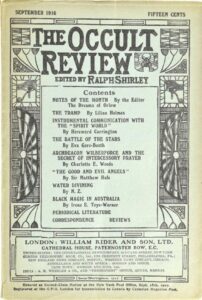
September 1916 US edition of The Occult Review
Not unusually for an active member of the occult revival, Shirley came from an aristocratic background. He was born in 1865, the youngest son of Walter Waddington Shirley, who, at the time of his death aged just thirty-eight, had been made Regius Professor of Ecclesiastical History at Oxford and Canon of Christ Church College. The Shirleys were descended from George Shirley (1559-1622) of Astwell Castle, Northamptonshire, and a later ancestor was created Earl Ferrers in 1711, a title passed down to Ralph’s elder brother in 1866. Ralph and his siblings were also close cousins of the literary Powys family (Ralph’s mother was C. F. Powys’s half-sister), and the two families were in regular contact during their childhoods and beyond. Ralph would distract the young John Cowper Powys by asking ‘How much wood, Cousin Jack, does a woodchuck chuck when a woodchuck would chuck wood?’ During the 1880s the Shirleys moved to Wyaston House, a Georgian rectory in Oxford now part of St Peter’s College, where the Powyses would visit them in the holidays. Ralph went up to New College in 1885, giving John Cowper access to the Bodleian. Of Ralph in this period, Powys remembered his ‘absolute’ love of poetry being ‘a kind of physical necessity, like smoking tobacco or drinking tea’. It was Ralph who later introduced Powys to the doctrines of theosophy, and, when at William Rider & Co., published Powys’s first two poetry collections (1896 & 1899).
Novelist John Cowper Powys (1872-1963)
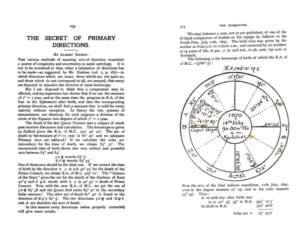
It was not long before Shirley became, as Powys puts it, ‘one of the Argonauts of Occultism in London’. He began to study astrology and astral projection under the tutelage of homeopathic physician Alfred J. Pearce, editor of Zadkiel’s Almanac and Star Lore and Future Events. He seems to have begun working for Rider at some point in the early 1890s. Rider were not yet purveyors of popular esotericism, but, according to Waite, owned the Timber Trades’ Journal and printed various manuals associated with it (thereby shielding the firm from bankruptcy). Shirley began a magazine of his own in 1902 devoted to astrology, The Horoscope, a quarterly edited under the pseudonym Rollo Ireton. Presumably this was meant to distance himself from his professional identity, at least for the time being. But The Horoscope, its pages dense with calculations and readings of current events, ran for only eight issues, folding in 1904. Shirley and the theosophist Walter Gorn Old (‘Sepharial’) wrote most of the contents, with gaps filled by astrologer George Wilde and others. The following year Shirley was already marshalling contributors for his next journal. On the suggestion of Gorn Old, he wrote to Waite asking to aid him in the new venture. Waite happily sent in an article questioning the journal’s title and arguing for a distinction to be made between the terms ‘occultism’ and ‘mysticism’, although since 1904 was the year of Horlick’s Magazine Waite did not write again until the October 1905 issue.
Clearly Shirley continued to be regarded as a talented astrologer within occult circles, for in 1907 he was giving W. B. Yeats lessons: ‘Last night I had Ralph Shirley a very good astrologer to dinner & showed him your horoscope he looked at [it] with delight as if it were the photograph of a young beauty & presently he said (I had said nothing) “what firmness of character, what a horoscope”. I am going to him tomorrow for a lesson’. (Yeats to Lady Gregory, [14 Dec 1907]). Shirley apparently taught Yeats some of the mathematical aspects to this branch of divination.
Pages from The Horoscope
The Occult Review debuted in January 1905, published by Rider. Rider’s move to focus on the occult did not occur until 1908, when it incorporated the publisher Philip Wellby, but Wellby’s name appears on the title page for the magazine’s first five volumes, suggesting a partnership that ended in mid-1907. Shirley’s introduction described the review as ‘devoted to the investigation of super-normal phenomena and the study and discussion of psychological problems’. Waite, then, could rest easy: mysticism rarely featured, and most articles addressed occultism in history, paranormal experiences, and psychic research (hypnotism, telepathy, etc.). The occult in literature was also a common theme. Recognisable names appearing during the first few years included Andrew Lang, R. H. Benson (on the Catholic Church’s attitude to the occult), John Cowper Powys, Edward Carpenter, and the Rhymer poet Edwin Ellis. More than a handful of contributors were, or had been in the 1890s, initiates in the Order of the Golden Dawn. Shirley had far more success than with The Horoscope: his only break during this period came in 1907, when Waite took over the editorship for several months, writing the Editor’s Notes column and, four years later, even took on the Periodical Literature section when its author passed away. (Waite gives the year as 1909 in his autobiography, but this seems inaccurate).
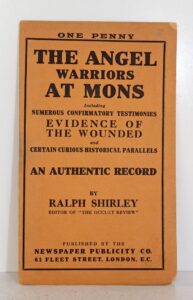
The Occult Review was useful to Shirley as a means of promotion for Rider’s output, such as when the firm released the tarot deck designed by A. E. Waite and illustrated by Pamela Colman Smith (becoming unjustly known as the Rider-Waite deck). In his Editorial Notes for December 1909, Shirley announced its publication alongside Waite’s explanatory essay The Key to the Tarot. Waite himself wrote a piece for the same issue in elaboration. No one begrudged Shirley for advertising his own firm’s products; from a business perspective, subscribers to The Occult Review were certain to be interested in other Rider publications. Shirley also knew Bram Stoker and published five of his novels, including a reprint of Dracula. For the release of The Lair of the White Worm (1911), Shirley (writing as ‘Scrutator’, a favoured pseudonym) wrote a biographical piece for The Occult Review and was disappointed to note that Stoker had not experienced any psychic phenomena: ‘He admits the facts of Hypnotism and has an interesting theory as to why dreams come true. But beyond this he reserves judgement’. Shirley’s interactions with writers of the supernatural continued when in autumn 1914 he became captivated by Arthur Machen’s war story ‘The Bowmen’ and wrote to Machen asking whether any of it was true. A year later, still refusing to accept it as a fiction, Shirley compiled a short book of soldiers’ eye-witness accounts of the angelic visions, The Angel Warriors at Mons.
The Angel Warriors at Mons (1915)
Shirley continued to edit The Occult Review until 1925 when he sold Rider and its occult publications to Hutchinson & Co., after which Harry J. Strutton took over the reins. The magazine went through several changes of identity, morphing into The London Forum in 1933 and finally Rider’s Review in 1947 until ceasing in 1958. During the last decades of his life Shirley sat on various committees, including as Vice President of the International Institute for Psychical Research and an advisory chairman for Light magazine, and wrote features on London history for The Contemporary Review. As his professional life suggests, Shirley was a respected and magnanimous publisher with a comprehensive love of literature and occult pursuits. As Powys remembered him, he was a ‘noble figure of a man … with his spacious forehead, Viking mustache’ whose aristocratic manner ‘seemed to me careless and charming instead of a morbid revenge upon life’. Wellby wrote his obituary for The OccultReview‘s April 1947 edition, praising his patience, self-discipline, and ‘earnest spiritual aspiration’. Shirley deserves more recognition than is now afforded him – or at least a more penetrating light is required to illuminate his many achievements and his role in the careers of the leading occult writers of his day.
An incomplete list of Ralph Shirley’s publications, almost all published by William Rider & Co.: 1911 – The New God and Other Essays
1914 – Prophecies and Omens of the Great War
1915 – The Angel Warriors at Mons (Newspaper Publicity Co.)
1919 – A Short Life of Abraham Lincoln
1920 – Occultists & Mystics of All Ages
[1936] – The Problem of Rebirth: An Enquiry into the Basis of the Reincarnationist Hypothesis
[1937] – The Mystery of the Human Double
Sources:
John Cowper Powys, Autobiography (New York: Simon & Schuster, 1934)
A. E. Waite, Shadows of Life and Thought (London: Selwyn and Blount, 1938)
R. A. Gilbert, A. E. Waite: Magician of Many Parts (Crucible, 1987)
P. S. W., ‘The Hon. Ralph Shirley’, The Occult Review LXXIV.2 (April 1947), p. 65. IAPSOP’s inventory of The Occult Review Shirley’s entry on Encyclopedia.com DNB entry for Shirley’s father Collected Letters of W. B. Yeats. Electronic Edition. Unpublished Letters (1905-1939).
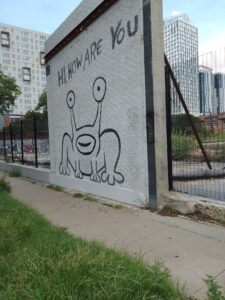
Daniel Johnston mural across the street from the Harry Ransom Centre
Attention, the sign read: storage of handguns is not allowed in these lockers or areas. Noted, I thought. Another example of the incongruous nature of my visit. This implied that enough handguns had been stored in the lockers that staff at the Harry Ransom Centre needed to put up the sign. It was better than bringing them into the reading room. Once inside, however, I thought no more of firearms in a library. Neither was the Texas heat an issue here. I could move with ease inside the temperature-controlled, air-conditioned space. As a librarian gave me an induction, I noticed R. A. Gilbert’s bibliography of scholar-mystic A. E. Waite on the shelf. Goldstone and Sweetser’s Machen bibliography was not far off. This was familiar ground. Machen’s eye-catching titles prompted the librarian to go back to the desk and look him up on Wikipedia.
The Harry Ransom Centre has links with Joyce (propitious – Machen read an early version of Dubliners for the publisher Grant Richards), and his bust is one of five or six modernists who greet the reader on their way up to the first floor.The original Ransom Centre was founded partly on oil money. Ransom himself, known as the ‘Great Acquisitor’, had to resign in 1971 because he was spending too much. He died five years later. One of his successors was Thomas F. Stanley, a man canny about persuading sellers to part with their sought-after archives. Since the last quarter of the twentieth century it became common for British critics to lament the fact that the papers of British authors were slowly being transferred to Austin. Julian Barnes sold his archive in 2002, Ian McEwan in 2014, Kazao Ishiguro the year after. Some do it for legacy reasons, others for the welcome cash at the end of a difficult career. Penelope Fitzgerald finally released her papers to Texas in 1988, ‘which gives me enough room to put my shoes’ (Letters, p. 316).
There can be no doubt that, had something like the Ransom Centre existed in the 1920s and 30s, Machen would have sold his own papers in a snap. In fact, a wholesale archival purchase may have saved him and his wife from many years of near poverty. Perpetually in need of money just to scrape by and beset by gout and liver failure, Machen appeared more than happy to sell individual items to fans and collectors, particular to Americans. He had even begun to ask for money before he signed anything (as many letters in the HRC attest: by 1927 he was charging autograph hunters £2-0-0 ). The actual Machen collection at the HRC was begun as far back as 1959, when the New York rare book dealer Lew D. Feldman sold a bundle of 575 letters Machen had written to Oliver Stonor. Feldman was instrumental in building up the main collections of HRC and the Berg Collection at the New York Public Library. After the Feldman purchase, regular donations by the bibliographer Adrian Goldstone helped swell the archive and continued until the late 1980s until the collection occupied 8.4 linear feet of shelf space.
So what’s actually in there? Of greatest interest is probably Machen’s notebook dating from the second half of the 1890s, full of jotting for stories and drafts of The Garden of Avallaunius (though this had been usefully transcribed and annotated by Tartarus Press several years ago). More jewels of the collection are the letters Machen composed to a handful of recipients during the last few decades of his life, amounting to over 1,000 items. There are the letters to Stonor, but also to New York bookseller Alfred Goldsmith, Colin Summerford, Harvard academic Robert Hillyer, and superfan John Gawsworth. The Gawsworth material itself is immense, and far too extensive for the short time I had. Reams of bibliographic questions for Machen to answer (On what date was X published? How did you get to know so and so?), on top of drafts of his unpublished biography, Man of Letters, running to many hundreds of pages. Gawsworth was an early Machen obsessive who amassed a strong set of Machenalia over the years. His failure to get the book published must have seemed a bitter reward for a project that had taken him years of research and pestering. Even after Machen’s death in 1947 attempts to secure publishing contracts fell through and Gawsworth was left to reminisce and to manage the estate of his other hero – M. P. Shiel.
Here be a Freak Show (2nd floor)
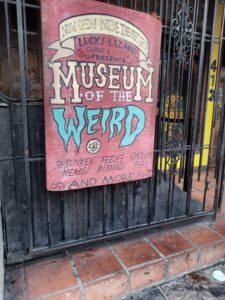
And so two days passed quickly: onlookers during the final hours would have seen me flicking desperately through the remaining folders, taking photos with abandon. The evenings were spent trying hard to melt through the tarmac into a nether-Austin, its frozen and less sweaty opposite. This meant I had little time for traditional site seeing. I did, however, get to the Museum of the Weird – south of the capitol building, a block away from Joe Rogan’s comedy club (another incongruity). Three unbeatable floors of an American-style cabinet of curiosities, topped off with a wax museum devoted to the owner’s obsession: Lon Chaney. Then after Jackalopes and wolf boys it was back to the accommodation to prepare for the 5am flight to JFK… The bulk of Machen was already over. But what would be waiting for me in the city of his correspondents?