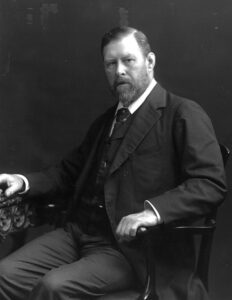
One of the more sensational episodes in the history of the Order of the Golden Dawn, now part of its legend, is the Battle of Blythe Road, so called by historian Ellic Howe because it took place at the Order’s premises in Blythe Road, Hammersmith. ‘Battle’ is one way of putting it, for no blows (magical or otherwise) were exchanged. What happened was a confrontation between two factions of the Order: a very young Aleister Crowley who represented the interests of the GD’s exiled leader, S. L. Mathers, and the poet W. B. Yeats, defender of the Order’s original vision. The major detail recalled by most people with passing knowledge of the Battle is apocryphal: that it concluded with Yeats kicking Crowley down a flight of stairs. It appears to have originated in an article written by Yeats biographer Richard Ellmann in 1948 marking Crowley’s death:
Making the sign of the pentacle inverted and shouting menaces at the adepts, Crowley climbed the stairs. But Yeats and two other white magicians came resolutely forward to meet him, ready to protect the holy place at any cost. When Crowley came within range the forces of good struck out with their feet and kicked him downstairs.
Crowley seems to have related this detail to Ellmann because it was not part of any of the eyewitness accounts. As the Hermetic Library puts it, ‘Yeats did not Yeet Baphomet’.
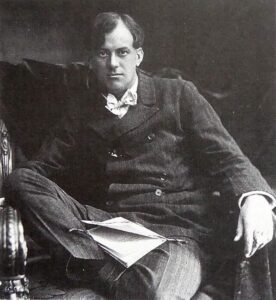
In February 1900 a revelation had thrown the GD into an identity crisis: Mathers claimed that the series of letters giving the original founders authority to establish the Order were forgeries. A committee was set up to investigate. Crowley was denied initiation into the Second Order in London for reasons to do with his sexual promiscuity (and, connected with this, an attempt to ‘gain magical power’), and so he had sought out Mathers at his home in Paris, who did not hesitate to initiate Crowley into the Ahathoor Temple. Though still commanding considerable influence in occult circles, Mathers had grown increasingly paranoid and dictatorial in his oversight of the GD in Anglia (in England). This was producing a rift between students loyal to Mathers and those who disagreed with his style of leadership, but his aspersions of forgery against co-founder William Westcott set the stage for the final break.
When it was made clear to Crowley that his Second Order initiation would not be officially recognised by Isis-Urania, he wrote to Mathers at the end of March ‘offering’ his service. While he waited for the reply, Crowley travelled to London where on 6 April he tried to gain entry to the Second Order’s headquarters at 36 Blythe Road. These were a set of first-floor room rented by actress Florence Farr from Mr C. E. Wilkinson, a builder whose office were on the ground floor. It was where the Second Order stored their ritual props (including a magnificent construction known as the Vault of the Adepts, the door of which was kept locked), and, importantly, documents relating to the Order including a list of initiates. A member named Maud Cracknell was on duty and refused Crowley entry. Cracknell seems to have misled him by claiming not to have a key to the Vault, and Crowley, unfamiliar with how the Second Order operated, believed her. Immediately Cracknell then wrote to another member explaining what had happened.
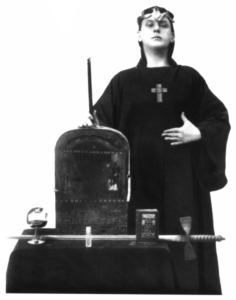
Before retreating to Paris, the thwarted Crowley met with two other members, Elaine Simpson and her mother Beatrice, to solicit their support for Mathers. Elaine was a new Second Order initiate, he reasoned, and could therefore be useful. Crowley then crossed the channel and was with Mathers and his wife Moina on 9 April where he submitted a list of ‘proposals’ for how he wished to proceed, including summoning all Second Order members to him in London. There he would then interrogate them individually (Crowley would be masked) ,and if members failed to recognise Mathers as the true head of the Order and refused to sign a written statement to that effect, then Crowley would expel them. He also proposed a new rule of anonymity: all members were to wear masks and were to know the identity only of the member who had first introduced them to the Order. Mathers approved, and sent Crowley on his way.
In hindsight this is all quite funny: Crowley’s arrogance and belief in his success are part of what gives the events of 16-19 April such bathos. He was twenty-four at the time, a relatively junior student, and here he was on his way back to London with the intent to grill senior members and take over as Mathers’s lieutenant. His actions were motivated by at least two factors: spite towards what he considered an elitist membership who had rejected him out of hand (this is certainly true from a literary standpoint; Crowley saw himself as a talented poet, but Yeats was scornful of the work Crowley showed him), and desire to seek real occult influence within the Order’s hierarchy. Mathers represented a direct link to the supernatural ‘Secret Chiefs’ who had supposedly communicated to him the teachings of the Second Order. ‘He was unquestionably a Magician of extraordinary attainment’, Crowley wrote in his Confessions: ‘He had that habit of authority which inspires confidence because it never doubts itself’. Crowley was snatching at power while getting back at those who had snubbed him.
On Monday 16 April Crowley was back at Blythe Road, this time with Elaine Simpson (who, as a recognised 5˚ = 6˚, was authorised to enter the rooms) and a set of keys borrowed from Edward Berridge, another follower of Mathers. Crowley changed the locks and added his own Order motto to the membership list: ‘Perdurabo, Jan. 23, 1900’. Edmund Hunter records what happened next.
On Tuesday, 17th instant, I received a telegram from Miss Cracknell to come at once to Blythe Road. On arriving I found that the rooms which had been closed by Order of Mrs. Emery [Florence Farr] had been broken into. On entering, after a certain resistance, I found there Aleister Crowley and Miss Elaine Simpson, who declared that they had taken possession by the authority of MacGregor Mathers, and showed me documents to that effect.
Florence Farr was summoned to the scene and fetched a constable, but Wilkinson was away and she could not prove ownership of the rooms. There was nothing to be done. Crowley recorded in his notebook: ‘Fight, police, victory’. The same day he sent off letters summoning all members to Headquarters on Friday (20 April) ‘By order of Deo Duce Comite Ferro [Mathers]’.
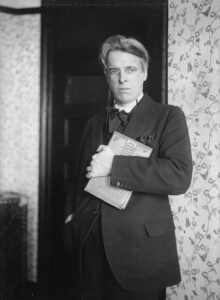
Yeats did not enter the fray until the morning of Thursday 19th. He and Edmund Hunter went early to see Wilkinson with a letter from Farr asking for the locks to be changed back. The two men then stood guard in the rooms until 11.30am when Crowley arrived in costume. He wore ‘Highland dress, a black mask over his face, and a plaid thrown over his head and shoulders, an enormous gold or gilt cross on his breast, and a dagger at his side’. Wilkinson stopped him in the back hall, and Yeats and Hunter came down. Once again, a constable was summoned, but this time ownership of the rooms could be proved, and Crowley had no choice but to leave. It was the final ‘theatrical farce’ in a fortnight of plans, posturing, and threats.
No one was kicked down a flight of stairs, but the Battle of Blythe Road was still decisive for the Order’s future. Mathers was exposed as a villain and was quickly suspended from the GD by the Committee in a meeting on 21 April where a new constitution was proposed. Yeats’s role in hindering Crowley’s plans was minor, but pitting the two poets against one another provides a neat representation of the wider schism in the GD. Yeats was devoted to ensuring the Order’s survival: magic was an important part of his creative and personal life, and to see it overthrown and disfigured was anathema. In contrast, Crowley was young and irreverent, overly ambitious (before he took Blythe Road, he had been preparing the dangerous Abra-Melin summoning ritual) and willing to side with an authoritarian leader for a chance at power (he would go on to reject Mathers and form his own ritual order). Yeats was an experienced poet and playwright, at the forefront of several literary movements; Crowley had written masses of derivative erotic verse, mostly unedited and privately printed at his own expense. The Battle of Blythe Road was a pivotal event and underscored the divide between two very different forces in occultism and literature.
Sources:
Ellic Howe, Magicians of the Golden Dawn (Aquarian Press, 1985)
The Hermetic Library website
Aleister Crowley, The Confessions of Aleister Crowley (Penguin, 1989)
See this very good video made by Niall McDevitt, filmed on present day Blythe Road for the Irish Cultural Centre.